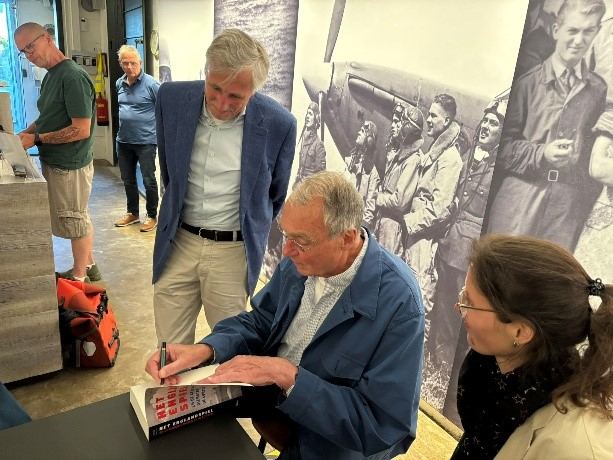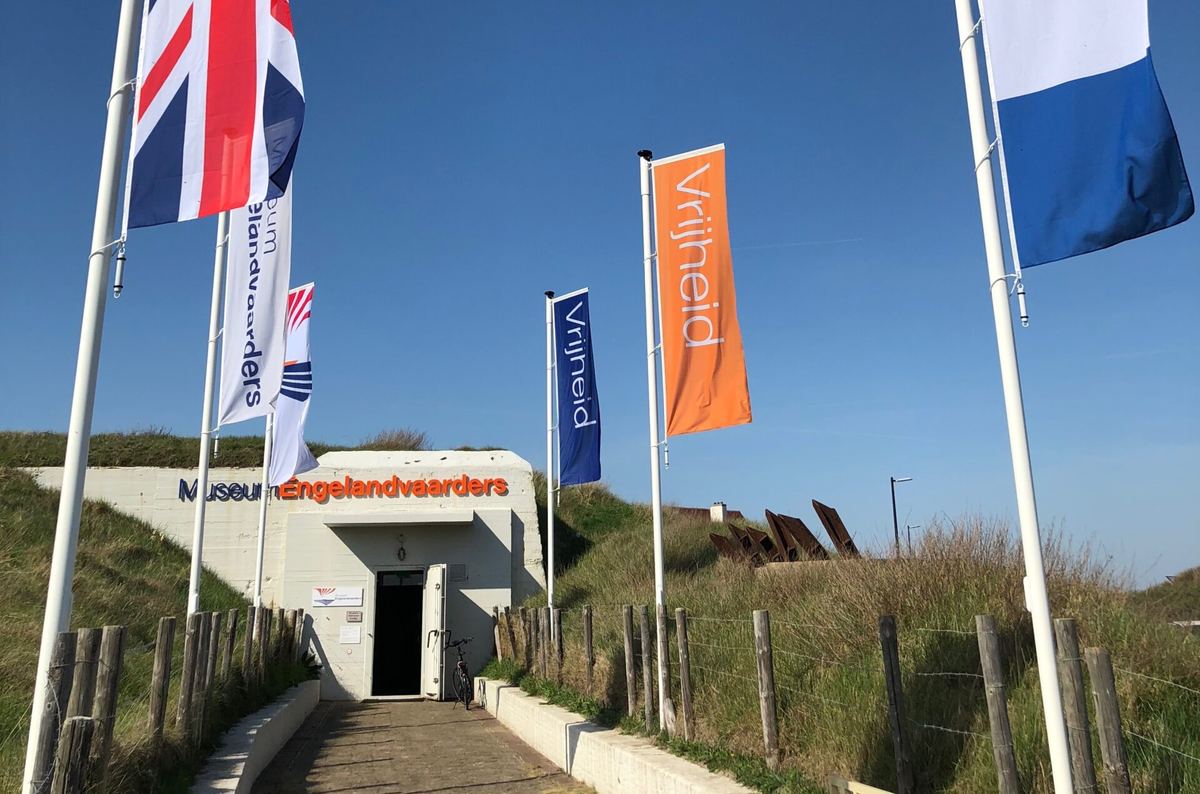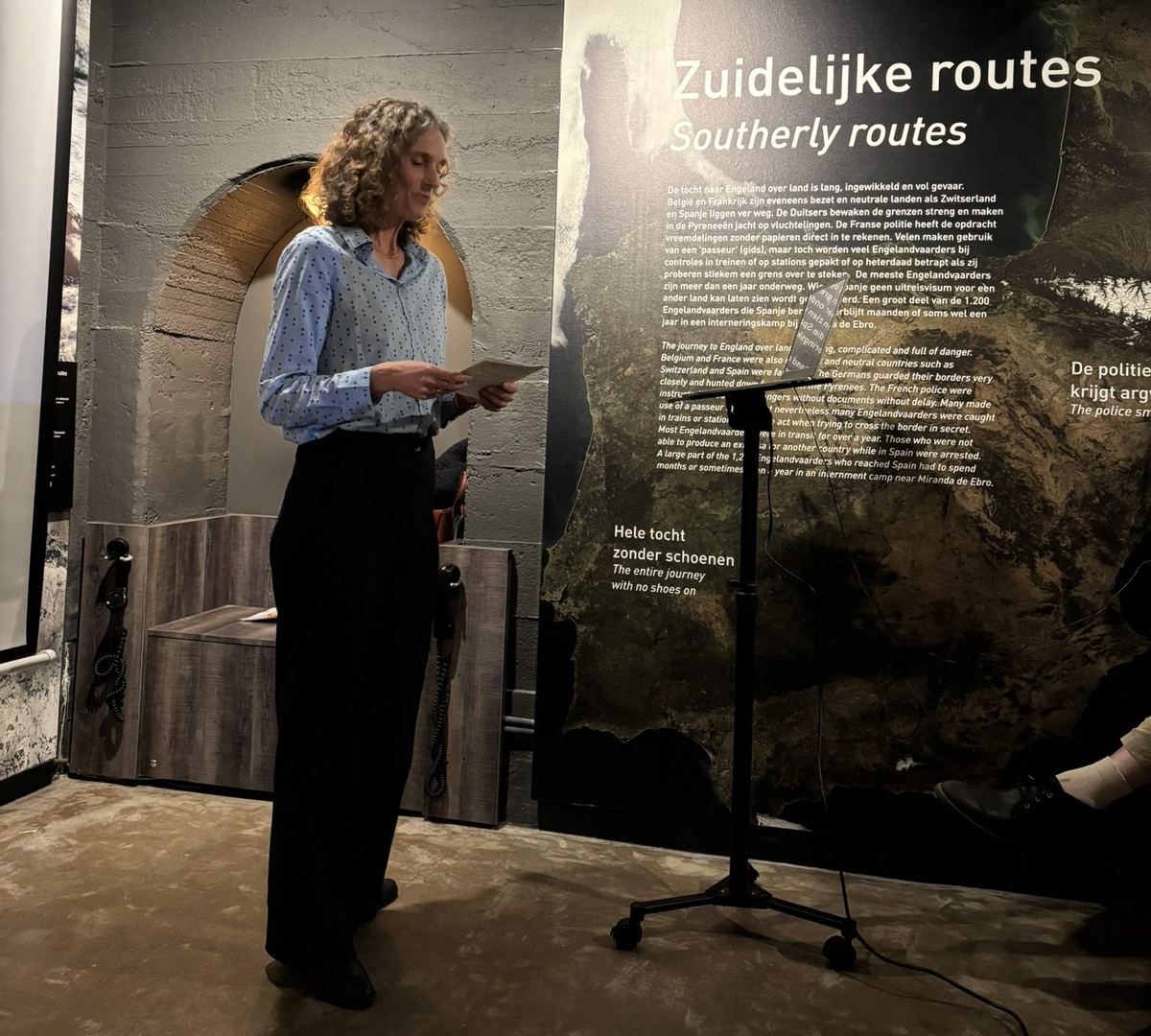
Last Thursday Marian Rijk, author of the book “De lange weg naar Londen” (The long road to London), gave an inspiring talk at the museum about “Engelandvaarder” Charles Pahud de Mortanges. Following the talk by Victor Laurentius on the book “Spion in Smoking” (about Peter Tazelaar) and the one by Frans Becker and Tamara Becker on the secret services in London, it was the third in the series Museum Engelandvaarders is organising this year.
While writing about forgotten Dutch Olympic heroes, Marian Rijk came across a story that sent her research in an unexpected direction. The starting point was Rie Mastenbroek, the 17-year-old girl from Rotterdam who became a world star at the 1936 Berlin Olympics, winning three gold medals and one silver. Those Games would later become known as Hitler’s propaganda Olympics, designed to show off the grandeur of the Third Reich.
But it was another striking incident at the same Games that caught her attention. In the equestrian events, something went wrong that should never have gone wrong. Charles Pahud de Mortanges, four-time Olympic champion and the pride of the Netherlands, was eliminated. During the jumping, his horse ‘Madel wie du’ landed awkwardly in the notorious pond, threw him and then refused three times. Expectations had been high; the disappointment was huge. Remarkably, while most of the international competitors came to grief at this obstacle, the German riders had no trouble at all. Rumours spread that they had known about hidden pits in the ground. Protests followed, but to no avail. Pahud remained diplomatic and loyal to his sport: “I never wanted to believe that it was deliberate.”
Rijk’s interest in Pahud grew – not only because of his sporting achievements (until 2024 he was the most successful Dutchman ever at the Summer Games) but above all because of his impressive role in the turbulent decades that followed. After the invasion in 1940 he founded Kareol, a rehabilitation centre in Aerdenhout for seriously wounded servicemen: a pioneering initiative built around sport and occupational therapy, at a time when rest was the usual prescription.
In May 1942, together with 2,000 Dutch regular officers, he was deported to a prisoner-of-war camp in Stanislau. During a temporary return to the Netherlands he managed to escape from a goods wagon using a small saw hidden in the hem of his coat. His goal: London. His son Buuk had set out as an “Engelandvaarder” a year earlier, but was arrested at the Swiss border and executed with four comrades on 19 March 1942.
Pahud’s journey to England – by the southern route known as the Weg Verhoef – became the core of Rijk’s research. The route was a network of escape lines, including Fiat Libertas and Dutch-Paris, used to smuggle resistance fighters, Jews, pilots and “Engelandvaarders” out of occupied territory. The journey was long, risky and exhausting: six borders, false papers, enemy territory and finally a gruelling crossing of the Pyrenees.
In London Pahud joined the Allies, became deputy commander of the Princess Irene Brigade and warned that Operation Market Garden was being underestimated. After the war he remained active as chairman of the Dutch Olympic Committee (NOC), a member of the IOC and head of Queen Juliana’s Military Household.
Rijk’s research sheds new light on a many-sided and courageous figure who, despite his impressive record, fell into obscurity. His story confronts the reader with a question that is still relevant: what would you do if your life, your country and your values were at stake? It is a question still worth asking today. It is not easy to answer here and now, but it is worthwhile to ask yourself from time to time, even when there is no urgency. The stories of the “Engelandvaarders” Pahud and Buuk make it clear that we should count our blessings every day. Our peace and security are not a given; they deserve to be cherished and guarded. Especially now.
Rijk hopes this story can convey that relevance. Above all, she hopes that even in difficult times there will always be people who stand up to make a difference for someone else or for the greater good.
The book “De lange weg naar Londen” is on sale in the museum shop.